
Electrical Code & Safety
GFCI vs AFCI: What's the Difference & Which Do You Need?
GFCI and AFCI protect against two completely different hazards — shock and fire. Here's what each one does, where Washington code requires them, and how to tell which your home is missing.
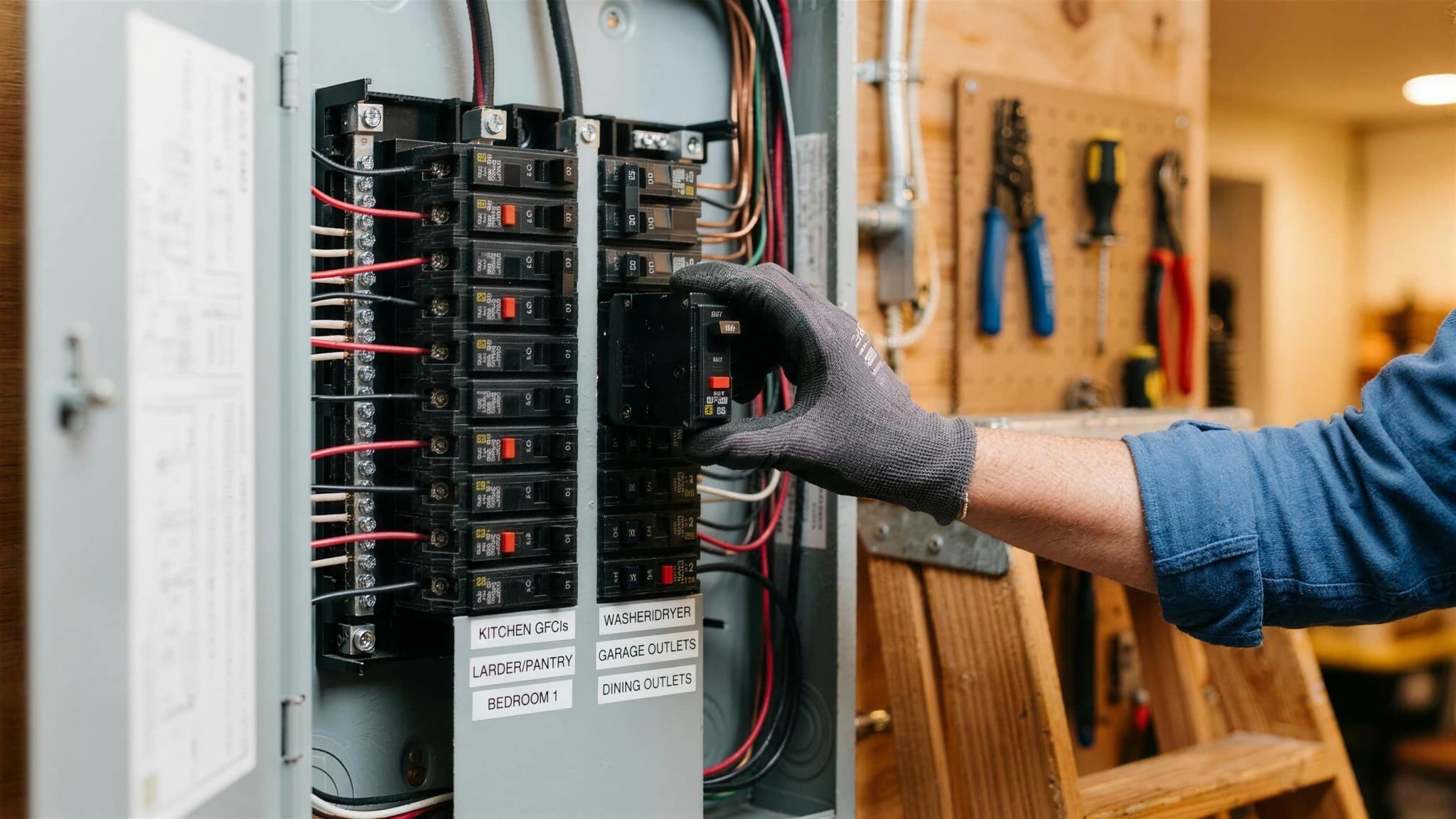
GFCI and AFCI get lumped together because they're both breakers with a test button, and beyond that people mix them up constantly. They protect against two completely different hazards. A GFCI — ground-fault circuit interrupter — protects you. It watches for current escaping toward ground and cuts power fast enough to prevent a lethal shock. An AFCI — arc- fault circuit interrupter — protects the house. It listens for the electrical signature of a dangerous arc, the kind of sparking connection that starts fires inside walls long before anyone smells smoke.
Both are required by code in most new work and most remodels, and the National Electrical Code assigns them to different rooms for a reason — bathrooms and kitchens are wet and low-risk for hidden arcing; bedrooms and living rooms are the opposite. Below is the difference in plain terms, where Washington code currently requires each one, what a dual-function breaker does when a circuit needs both, and how to tell if your own panel is missing either protection — the same walkthrough we do on service calls and panel upgrades across the greater Seattle area.
What Is a GFCI (Ground-Fault Circuit Interrupter)?
A GFCI constantly compares the current leaving a circuit on the hot wire against the current returning on the neutral. In a healthy circuit those two numbers match exactly — every electron that leaves comes back the same path. The moment they're off by more than about 4 to 6 milliamps, the GFCI knows current is leaking somewhere it shouldn't — through water, a damaged cord, or a person — and it cuts power in as little as 1/40th of a second, fast enough to stop a shock before it becomes dangerous. That's a genuinely small amount of current: a human body can feel 1 milliamp and start losing muscle control well before 100, which is why a standard breaker, built only to catch overloads, has no idea any of this ever happened.
GFCIs come in two forms. A GFCI outlet has its own test and reset buttons and protects itself, plus anything wired downstream of it on the same run. A GFCI breaker sits in the panel and protects the whole circuit from the source, which is often the simpler answer for a garage or an outdoor circuit feeding several outlets.
What Is an AFCI (Arc-Fault Circuit Interrupter)?
An AFCI reads the electrical signature of the current itself, watching for the erratic, chattering pattern an arc makes — a loose wire nut, a nail through a cable, a cord pinched under a rug leg, a staple driven through romex during a remodel decades ago. Ordinary switching and motor starts also create small arcs, so the electronics inside an AFCI have to tell a light switch clicking on from a connection slowly cooking inside a wall. That's the entire engineering challenge, and it's why AFCIs are more sophisticated — and pricier — than GFCIs.
A standard breaker only responds to too much current. An arcing fault often draws a perfectly normal amount of current right up until it starts a fire, which is exactly why it can go undetected by ordinary overcurrent protection. Combination-type AFCIs — the kind required today — catch both parallel arcs (line to neutral or ground) and the harder-to-detect series arcs, where a single conductor is damaged along its length. Nearly all AFCI protection lives in the panel as a breaker, though branch-circuit AFCI outlets exist for specific retrofit situations.
| What | GFCI | AFCI |
|---|---|---|
| Protects against | Electric shock (ground faults) | Electrical fire (arcing faults) |
| What it detects | Current imbalance between hot & neutral | Erratic arc signature in the current |
| Trip trigger | ~4–6 milliamps of leakage | A detected arc pattern, not a current amount |
| Common form | Outlet or breaker | Breaker (branch-circuit outlets exist) |
| Typical rooms | Bathrooms, kitchens, garages, outdoors, laundry | Bedrooms, living areas, kitchens, laundry, hallways |
Not Interchangeable
A GFCI can't detect an arcing fault, and an AFCI can't detect a ground fault — they're solving different problems with different electronics. Swapping one for the other doesn't add protection, it just changes which hazard you're covered against. Where code requires both, you need both — either as two separate devices, or one dual-function breaker that does both jobs from the panel.
Not Sure What's in Your Panel?
Get a Straight Answer on GFCI & AFCI Coverage
Mad Dog Electric checks every breaker against current code during a panel inspection or upgrade — free site visit, a plain-English rundown of what's missing, and a fixed price before anything changes.
Where Washington Code Requires Each One in 2026
Washington adopts the National Electrical Code as its base standard, currently the 2023 edition — and L&I has already scheduled the 2026 NEC to take its place, effective December 31, 2026. Under the code in effect today, GFCI and AFCI protection between them cover almost the entire house, just in different rooms.
Where GFCI Protection Is Required
- Bathrooms — every receptacle
- Kitchens — every receptacle, not just countertop ones, under the 2023 update
- Garages and accessory buildings
- Outdoors, including decks and balconies
- Unfinished basements and crawlspaces
- Laundry areas, and within 6 feet of a wet bar sink
- Dishwasher, range, and other major kitchen appliance circuits — added in the 2023 update
Where AFCI Protection Is Required
Nearly every 120-volt, 15- or 20-amp branch circuit feeding outlets or devices in a dwelling needs AFCI protection — kitchens, family rooms, dining rooms, living rooms, parlors, libraries, dens, bedrooms, sunrooms, recreation rooms, closets, hallways, and similar rooms or areas. In practice, that's most of the floor plan outside the GFCI zones above.
Where They Overlap: Dual-Function Breakers
Kitchens and laundry areas land on both lists, so those circuits need both protections. Rather than stacking a GFCI outlet downstream of an AFCI breaker, most panels get a single dual-function — also called combination AFCI/GFCI — breaker that does both jobs from the panel out. It costs more than either device alone, but it's one breaker, one test button, and one thing to maintain instead of two. A smart electrical panel makes it easy to see which circuits are covered which way, right from your phone.
Does an Older Home Have to Be Retrofitted?
Generally, no. Electrical code isn't retroactive — a home wired to the standard in effect when it was built or last permitted stays legal as-is. What actually triggers an upgrade is new permitted work: a kitchen remodel, a bedroom addition, a panel replacement, or even swapping out a single failed breaker typically has to meet current code for that circuit. That's the ordinary, gradual way GFCI and AFCI protection spreads through an older house — one remodel, one panel, one failed breaker at a time, rather than all at once.
Homes still running original 1960s-and-earlier wiring or panels tend to have the least protection of either kind. If that describes yours, our guide to knob-and-tube wiring covers what that means for safety and insurance, and whether it's time to plan a rewire rather than chase code compliance one circuit at a time.
What It Costs to Add GFCI or AFCI Protection
A single GFCI outlet, installed by a licensed electrician, typically runs $150 to $250 including the device — less for a straightforward swap, more if the box is old or ungrounded and needs extra work to do safely. An AFCI or dual-function breaker added to an existing panel usually lands around $200 to $350 per circuit; the breakers themselves cost noticeably more than a standard one, and not every panel brand stocks a compatible unit off the shelf.
If a home is missing protection across most of the house, it's almost always cheaper and cleaner to fold it into a broader panel upgrade rather than adding breakers one at a time — see our panel upgrade cost guide for the full breakdown of what drives that number.
Testing & Signs of Trouble
Both device types have a test button, and both are worth pressing monthly — it's a ten-second habit that confirms the protection is actually working. GFCIs typically last 10 to 15 years before the mechanism wears out; if one won't reset on an empty circuit, or won't trip at all when you press TEST, treat that as a failed device, not a nuisance. If breakers in your panel keep tripping and you're trying to work out whether it's an overload, a short, or a ground fault, our guide to a circuit breaker that keeps tripping walks through the diagnosis step by step, and our guide to an outlet that's dead with no tripped breaker covers the GFCI-specific version of that same mystery.
When to Call a Licensed Electrician
- No breaker in the panel has a test button and there's no visible GFCI outlet anywhere in the house
- A GFCI won't reset even with everything unplugged, or an AFCI trips repeatedly with nothing obviously wrong
- You're planning a kitchen, bathroom, or bedroom remodel — that's the moment code compliance gets checked
- A home inspector or insurer has flagged missing GFCI or AFCI protection during a sale or a policy renewal
- You're not sure which breakers are which — a five-minute panel check answers it for good
GFCI and AFCI aren't competing technologies and neither one is optional where code requires it — they're two separate layers of protection covering two separate hazards, and a well-protected home in the greater Seattle area has both. Mad Dog Electric is a licensed Washington electrical contractor (MADDODE754OB) that checks GFCI and AFCI coverage on every panel job and safety inspection, from a single breaker swap to a full panel upgrade across the greater Seattle area.
FAQ
Frequently Asked
Questions
Time to Check What Your Panel Is Missing?
Mad Dog Electric verifies GFCI and AFCI protection on every panel upgrade and safety inspection across Seattle, Bellevue, Everett, and the rest of the greater Seattle area — free site visit, straight answers, fixed price before anything is ordered.