
Electrical Tips
Outlet Not Working but Breaker Not Tripped? Troubleshooting Guide
The safe order to check a dead outlet — hidden GFCIs, sneaky wall switches, half-tripped breakers — and the exact point where you stop and call a pro.
An outlet not working while every breaker in the panel looks fine is one of the most common calls we run — and nine times out of ten it's one of three things: a tripped GFCI hiding somewhere upstream, a half-hot outlet controlled by a wall switch, or a loose connection behind the receptacle. The first two you can fix yourself in about five minutes, no tools required. The third one is where you stop.
This guide walks the exact order we use on service calls across the greater Seattle area: rule out the simple stuff, hunt down every GFCI in the house, give the panel a proper second look, then draw a hard line at anything that means opening a box. An electrical outlet that's not working is usually a cheap fix — but a loose, arcing connection is sometimes the polite warning you get before a hot one.
One more thing before you start: if dead outlets keep multiplying around your house, the problem may not be the outlets at all. Aging panels and tired circuits show up constantly on our panel upgrades & remodels jobs in homes built from the '70s through the '90s — worth keeping in the back of your mind as you troubleshoot.
Start With the Five-Minute Checklist
Work this list in order before you reach for a screwdriver. It solves the easy 80 percent of dead outlets and costs you exactly nothing:
- Swap the device — plug a lamp or charger you know works into the dead outlet, and try the dead device somewhere else. Sometimes it's the device, not the outlet.
- Try both halves — the top and bottom of a receptacle can be wired separately, so test each one.
- Flip every wall switch in the room — a switched outlet plays dead until its switch is on.
- Reset every GFCI in the house — bathrooms, kitchen, laundry, garage, basement, crawlspace, and outside. One tripped GFCI can kill a whole run of normal-looking outlets.
- Recheck the panel — a tripped breaker can sit almost perfectly in line with the others. Push each one firmly to OFF, then snap it back to ON.
The One Tool Worth Owning
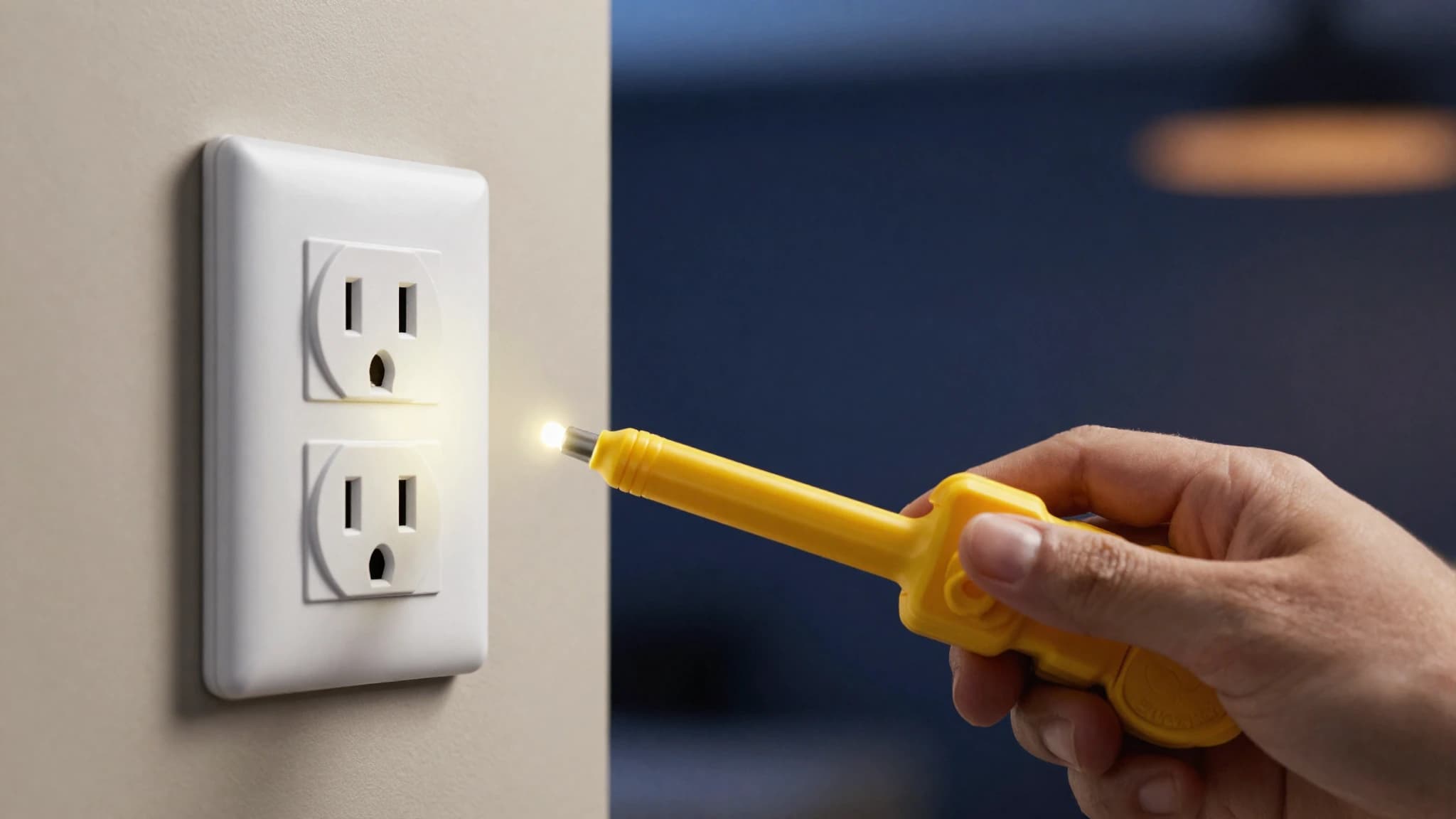
A plug-in outlet tester costs about ten bucks at any hardware store and tells you in two seconds whether an outlet is dead, miswired, or missing its ground. Three little lights, a legend printed on the front, zero expertise required. It turns “I think it's dead” into “it's dead, and the neutral is open” — exactly the kind of detail that makes an electrician's visit faster and cheaper.
Safety First
If an outlet is warm to the touch, buzzing, sparking, or smells like burnt plastic, stop troubleshooting. Flip the breaker for that circuit off and call a licensed electrician the same day. And never pull a cover plate or open the panel beyond flipping breakers — you can't tell a live wire from a dead one by looking at it.
GFCI Outlet Not Working?
The GFCI — ground-fault circuit interrupter, the outlet with the TEST and RESET buttons — is the number-one reason for a dead outlet with no tripped breaker. Its job is simple: it compares the current flowing out with the current flowing back, and if even about 5 milliamps goes missing — leaking through water, a damaged cord, or a person — it cuts the power in a fraction of a second.
Here's the part most homeowners don't know: one GFCI can protect every regular outlet downstream of it on the same circuit. Builders use this trick because it's cheaper than putting a GFCI at every location — so the plain-looking outlet on your patio may be guarded by a GFCI in the garage. When that one device trips, the whole chain goes dark, and the panel never shows a thing.
Where GFCIs Hide
- Bathrooms and kitchen counters — the obvious ones
- Garage walls — often behind shelving, the freezer, or a stack of boxes
- Unfinished basements and crawlspaces — bring a flashlight
- Laundry rooms and utility sinks
- Exterior walls — front porch, back patio, and near the meter
To reset one, press TEST first — you should hear a click — then press RESET firmly until it latches. A soft half-push won't do it, and a GFCI that trips again immediately with nothing plugged in is telling you something.
When a GFCI Fails for Good
GFCIs are mechanical devices, and they wear out — 10 to 15 years is a typical lifespan, less in a damp garage or on an exterior wall. Most fail exactly the way you'd want them to: dead, with a RESET button that won't hold even with nothing plugged in, and models made in the last decade self-test and shut off the power — or flash a warning light — when they fail. Replacement is a pro job. Newer GFCIs refuse to reset if the LINE and LOAD wires get swapped, while a swapped connection on an older unit can leave outlets live with no ground-fault protection at all. That's not a gamble worth ten saved minutes.
The Sneaky Switched Outlet
In living rooms and bedrooms without overhead lights, builders wire the top or bottom half of a receptacle to a wall switch by the door so a lamp comes on when you walk in. It's called a half-hot or switched outlet, and it fools people constantly: somebody flips the mystery switch on the way out, and the outlet “dies.”
Test the outlet with every nearby switch in both positions, and test both halves each time. If you find a half-hot outlet you'd rather have on all the time, an electrician can convert it quickly — and if the real problem is a lamp posing as your main light, proper ceiling fixtures are a straightforward residential lighting job.
Need a Hand?
Checked Everything, Still Dead?
Mad Dog Electric runs diagnostic visits across the greater Seattle area — licensed, bonded & insured, and you get a hard quote before we open a single box.
Common Culprits & Typical Costs
Every house is different, and we don't quote real jobs from a blog table — but round numbers keep you from getting soaked. The usual suspects, and what fixing them typically runs:
| Culprit | How You Spot It | Typical Fix |
|---|---|---|
| Tripped GFCI upstream | Dead outlets in bathrooms, the garage, or outside; the panel looks normal | Free — find it and press RESET |
| Switched (half-hot) outlet | Only one half is dead; comes alive with a certain wall switch | Free — or roughly $150–$250 to rewire it always-hot |
| Worn-out GFCI | Won't reset, no indicator light, or trips with nothing plugged in | Pro replacement, typically $150–$300 |
| Worn receptacle | Plugs sag or fall out; power cuts in and out when the cord moves | Pro replacement, typically $100–$250 |
| Loose or burned connection | Several outlets dead on one run; sometimes warmth or a burnt smell | Diagnosis and repair, often $150–$400 |
| Breaker tripped internally | A whole room dead; the handle looks normal but feels soft | Free — firm off-then-on reset |
When Mad Dog quotes a repair, the number you hear is the number you pay — hard-quote pricing, written down before the work starts. No “while we were in there” line items.
Outlets Not Working, Breaker Not Tripped
When several outlets stop working at once, every GFCI checks out, and the breaker still isn't tripped, you're usually looking at a failed connection inside a box. Power leaves the panel just fine — it dies somewhere along the chain.
The most common offender is the backstab connection. In production-built homes, especially from the '70s through the early 2000s, installers pushed wires into spring-grip holes in the back of each receptacle instead of wrapping them around the screw terminals. It's fast on a job site and notorious twenty years later: the spring relaxes, the connection loosens, and every outlet downstream goes dead. Heat from big loads — space heaters are the classic — speeds the whole thing up.
Here's the trap: the broken connection usually isn't in the dead outlet. It's in the last working outlet before the dead run, or in a junction box you can't even see. Worn receptacles that won't grip a plug and burned wire nuts round out the list. All of it means opening boxes on a circuit that's still live at the panel — and a loose connection doesn't just cut power, it arcs, and arcing makes heat inside your walls. This is call-an-electrician territory, full stop.
Outdoor Outlet Not Working
Around Puget Sound, an outdoor outlet not working in November is practically a season. Outdoor receptacles are required to have GFCI protection, and moisture is exactly what GFCIs are built to detect — so nine months of sideways rain means outdoor outlets here trip more than anything else in the house.
Start with the reset: the GFCI may be the outdoor outlet itself, or a feeder GFCI in the garage, basement, or a bathroom. If it resets and holds once things dry out, moisture got in. If it trips every time it rains, the outlet or its cover is letting water reach the contacts.
Two upgrades fix that for good. Modern code calls for weather-resistant (WR) receptacles outdoors — they shrug off the damp that corrodes standard outlets. And an in-use “bubble” cover seals over the cord while something is plugged in, which matters from Thanksgiving through New Year's when the holiday lights stay connected around the clock. The old flat flip-covers only protect an empty outlet.
Bathroom Outlets Not Working
If every bathroom outlet in the house died at once, that's not a haunting — it's one GFCI. Builders typically feed all the bathroom receptacles in a home from a single GFCI outlet, usually in the primary bath or the bathroom closest to the panel. A hair dryer or curling iron trips it, and suddenly three bathrooms are dead while the panel looks perfect.
Find the one bathroom outlet with TEST and RESET buttons and press RESET firmly. If it holds, you're done. If it won't hold, either something on the circuit is genuinely leaking current — water in an outlet box is common — or the GFCI has reached the end of the road. Either way, that's a quick, inexpensive visit for a pro, not a weekend project.
When to Call the Pack
Our rule for homeowners is simple: flip switches, press buttons, reset breakers — but never remove a cover plate, never open the panel, and never touch a circuit you can't verify is dead with a tester. If you have to ask how to verify that, you have your answer.
A diagnostic visit is straightforward: we confirm power at the breaker, trace the circuit outlet to outlet with a voltage tester, open the right boxes with the circuit safely dead, find the loose backstab or burned splice, and repair it properly — conductors pigtailed to screw terminals, worn receptacles replaced, protection tested before we leave. Most dead-outlet calls are done inside a couple of hours.
Mad Dog Electric is a licensed, bonded & insured Washington electrical contractor (license MADDODE754OB) with a 5.0 Google rating, and every estimate is free. Reach out through the contact form or give us a call — the pack covers Seattle and the whole greater Seattle area.
A dead outlet is usually a five-minute fix and occasionally a serious warning — knowing which is which is the whole game. If the same circuit also trips at the panel, read our guide on why a circuit breaker keeps tripping — and if your lights dim when the furnace kicks on, start with why your lights are flickering.
FAQ
Frequently Asked
Questions
Outlet Still Dead?
Book a free estimate with Mad Dog Electric — upfront hard-quote pricing, a licensed and insured crew, and honest answers before any work starts.