
Older Homes & Rewiring
Knob-and-Tube Wiring:Is It Safe & What Does Replacement Cost?
What knob-and-tube wiring is, how to recognize it, why it's a safety and insurance problem today, and what an honest replacement typically costs.
Knob-and-tube wiring is one of the most common questions we get from owners of older Pacific Northwest homes, and it usually comes up for one of two reasons: a home inspector flagged it during a sale, or an insurer started asking pointed questions at renewal. Either way, the short version is this — knob-and-tube wasn't bad wiring for the era it was built in, but it has no ground, its insulation is decades past its intended life, and it wasn't designed for the loads or the insulation standards of a modern house. That combination is why it's become a safety and an insurance problem rather than just a quirky old-house detail.
This guide covers what knob-and-tube wiring actually is, how to spot it in your own attic or basement, when it stopped being installed, why it's risky today, what it means for your homeowners insurance, and what a real replacement involves and typically costs. It's the same evaluation we run in the field on our panel upgrade & rewiring work across the greater Seattle area.
What Is Knob-and-Tube Wiring?
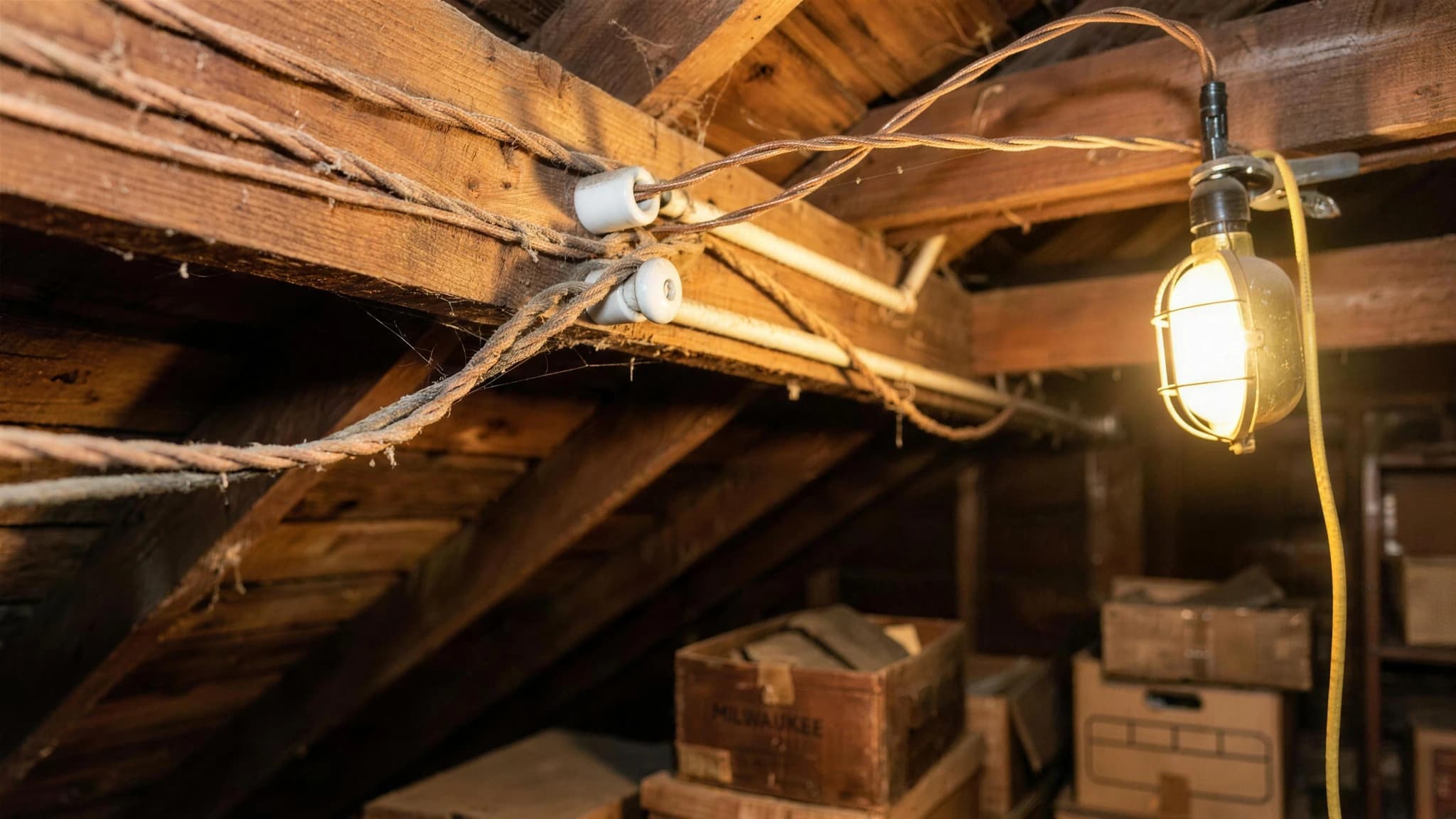
Knob-and-tube wiring is one of the earliest standardized methods for wiring a house. Instead of a single cable bundling the conductors together the way modern NM (“Romex”) cable does, knob-and-tube runs individual hot and neutral wires separately through open air. Ceramic knobs, nailed to the framing, hold each wire a short distance off the wood; ceramic tubes are set into holes drilled through joists and studs so the wire can pass through framing without touching it directly. The conductors themselves are solid copper, wrapped in rubber or cloth insulation rather than plastic.
There are two design features that made sense in 1910 and cause most of today's problems. First, the open-air spacing was intentional — it let the wires shed heat into the surrounding air, since the insulation of the day wasn't rated to handle heat buildup the way modern thermoplastic insulation is. Second, there's no ground conductor anywhere in the system, because grounding simply wasn't part of residential electrical practice yet. Both of those design choices are the exact reason knob-and-tube causes trouble in a 21st-century house.
How to Recognize It in Your Home
Most homeowners never see their wiring at all — it's the unfinished spaces where knob-and-tube gives itself away. Look for:
- White or brown ceramic knobs and tubes visible in an unfinished attic, basement, or crawlspace, with wires strung between them
- Single conductors with cloth- or rubber-braided insulation, rather than a single plastic-sheathed cable bundling wires together
- Two-prong (ungrounded) outlets throughout the house, with no third grounding hole
- A home built before roughly 1950 that hasn't had a documented full rewire since
- A prior home inspection report or seller's disclosure that already mentions it
None of this is a DIY inspection you should stop at, though — the visible knobs and tubes in the attic only tell you it exists somewhere in the house, not how much of it remains, whether it's been spliced into modern wiring, or whether it's buried in insulation you can't see. That takes a licensed electrician physically tracing circuits.
When Did They Stop Using Knob-and-Tube Wiring?
Knob-and-tube was the standard residential wiring method roughly from the 1880s through the 1940s. It was gradually replaced through the 1940s and 1950s as armored cable and then plastic- sheathed NM cable took over, and most electrical codes had moved on from it for new installations by the 1950s. In practice, that means any home built before about 1950 is worth checking, and it's common to still find sections of original knob-and-tube in homes built into the early 1960s — particularly in attics, additions, or rooms that a later remodel skipped over. Seattle, Everett, and the rest of the region have no shortage of homes from exactly that window.
The Single Biggest Modern Hazard
Knob-and-tube was engineered to dissipate heat into open air. Decades later, plenty of attics got a layer of blown-in insulation added for energy efficiency — with nobody realizing that burying knob-and-tube wiring traps the heat it was designed to shed. That combination, insulation over open-air-rated wiring, is one of the most common sources of knob-and-tube-related house fires, and it's often invisible until someone opens up the attic.
Found Ceramic Knobs in Your Attic?
Get a Real Evaluation of Your Wiring
Mad Dog Electric traces knob-and-tube circuits room by room across the greater Seattle area — free evaluation, honest assessment of how much remains, and a hard quote before any work starts.
Is Knob-and-Tube Wiring Safe?
Original, undisturbed knob-and-tube wiring in open air, carrying modest loads, can keep functioning without a dramatic failure — which is exactly why so much of it is still quietly in service in older homes. But “still working” isn't the same question as “safe by today's standard,” and the honest answer is that it fails that second test. It has no ground conductor, its insulation is well past the service life anyone designed it for, and decades of remodels, additions, and quick DIY fixes have given plenty of knob-and-tube systems splices and connections nobody today would sign off on.
Why Is Knob-and-Tube Wiring Dangerous Today?
A handful of issues compound each other, and it's the combination — not any single one — that makes an older knob-and-tube system worth taking seriously:
- No ground wire — a fault has no safe path back to the panel, so instead of tripping a breaker cleanly it can energize a metal fixture, appliance, or junction box
- Brittle, aging insulation— rubber and cloth insulation dries out, cracks, and flakes with decades of heat cycling, especially anywhere it's been disturbed by later work
- Buried in insulation — wiring engineered to shed heat into open air, now trapped under blown-in attic insulation added decades later for energy efficiency
- Unsafe DIY splices — wire nuts or electrical tape used to join conductors outside of an accessible junction box, a shortcut we still find in older attics and basements
- Never sized for modern loads — a system built for a few lamps and a radio, now asked to run space heaters, entertainment centers, and kitchen appliances it was never rated for
Can You Get Homeowners Insurance With Knob-and-Tube Wiring?
This is where knob-and-tube stops being just a maintenance question and starts affecting your ability to buy, sell, or renew coverage on a house. Many insurers won't write a new policy, or won't renew an existing one, on a home with active knob-and-tube wiring — the same scrutiny they apply to recalled Federal Pacific and Zinsco panels. Whether insurance will cover a home with knob-and-tube still in place depends entirely on the carrier: some will insure it if a licensed electrician documents that it's been inspected, isn't buried in insulation, and is in safe working condition; others require it to be replaced, full stop, before they'll issue or renew a policy.
If you're buying a home with knob-and-tube, financing itself can also get complicated — some lenders and insurers treat it as a closing condition. The practical move either way is finding out where your specific insurer stands before you're surprised by a non-renewal notice or a financing contingency you didn't see coming.
Repair or Full Replacement?
Patching a single damaged run of knob-and-tube is possible, but it's rarely where the job should stop. If an electrician finds one section of brittle insulation or a bad splice, it's a fair bet the rest of the circuit — installed the same year, by the same crew, to the same standard — is aging out right along with it. A spot repair can buy time on a single problem area, but it doesn't solve the underlying issues of no ground and aging insulation across the rest of the house, and it won't satisfy an insurer asking about knob-and-tube in general. For most homes, once a section is opened up and evaluated, a full or room-by-room rewire is the fix that actually resolves the safety and insurance questions instead of postponing them.
How to Replace Knob-and-Tube Wiring
A knob-and-tube replacement is a full or partial rewire, and it follows a fairly consistent sequence regardless of house size:
- Evaluation — an electrician traces circuits from the panel outward to map exactly how much knob-and-tube remains, and where
- Planning — deciding whether the job is a full rewire or a room-by-room approach that lets the family keep living in the home during the project
- New circuits — modern grounded NM cable run to every outlet, switch, and fixture, replacing the knob-and-tube run for run
- Panel work — a rewire often surfaces the need for a panel upgrade at the same time, since old fuse boxes and knob-and-tube usually date to the same era
- Patch and finish — wherever walls or ceilings had to be opened to run new cable, drywall and paint touch-up closes the loop
- Permit and inspection— every knob-and-tube replacement is permitted electrical work, and it gets signed off by the local inspecting authority before it's done
Where possible, a lot of this work happens in attics, basements, and crawlspaces with minimal disruption to finished living space — it's only where knob-and-tube runs through finished walls that opening drywall becomes part of the project.
Cost to Replace Knob-and-Tube Wiring & Cost to Rewire a House
There's no honest single number here — the cost to replace knob-and-tube wiring depends on the size of the house, how much of it still has original wiring, how easy the attic, basement, and crawlspace are to access, and whether walls need to be opened and patched. That said, some broad, typical ranges are useful for budgeting purposes:
| Scope | Typical Range | Notes |
|---|---|---|
| Partial / room-by-room replacement | Typically a few thousand dollars | Targets the sections still on knob-and-tube; scope grows with wall access needed |
| Full-home rewire, easy access | Typically well into five figures for a mid-size home | Open attic, basement, and crawlspace keep drywall repair to a minimum |
| Full-home rewire, finished walls | Typically the higher end of a whole-house rewire budget | Larger or multi-story homes with plaster or finished ceilings add drywall and paint costs |
| Panel upgrade, if bundled | See our panel upgrade cost guide | Common to pair with a rewire since both trace back to the original service |
| Permit & inspection | A modest add-on cost | Required for any knob-and-tube replacement; built into the quote |
Treat these as planning ranges, not a quote — the cost to rewire a house swings on details a table can't capture, like whether the crawlspace is a comfortable crawl or a tight squeeze, and how many circuits are involved. The only way to get a real number is a walkthrough with a licensed electrician, which is exactly how we start every knob-and-tube job across the greater Seattle area.
FAQ
Frequently Asked
Questions
Still Have Knob-and-Tube Wiring?
Mad Dog Electric evaluates and replaces knob-and-tube wiring for older homes across Everett, Seattle, and the rest of the greater Seattle area — free estimate, honest scope, permit included.