
Electrical Code & Safety
Federal Pacific Panels: Are They Safe& Should You Replace Yours?
Millions of homes built between 1950 and 1990 got a Federal Pacific Stab-Lok breaker box — and its breakers have a documented history of failing to trip. How to identify one, what the record actually shows, and what replacement involves in the Seattle area.
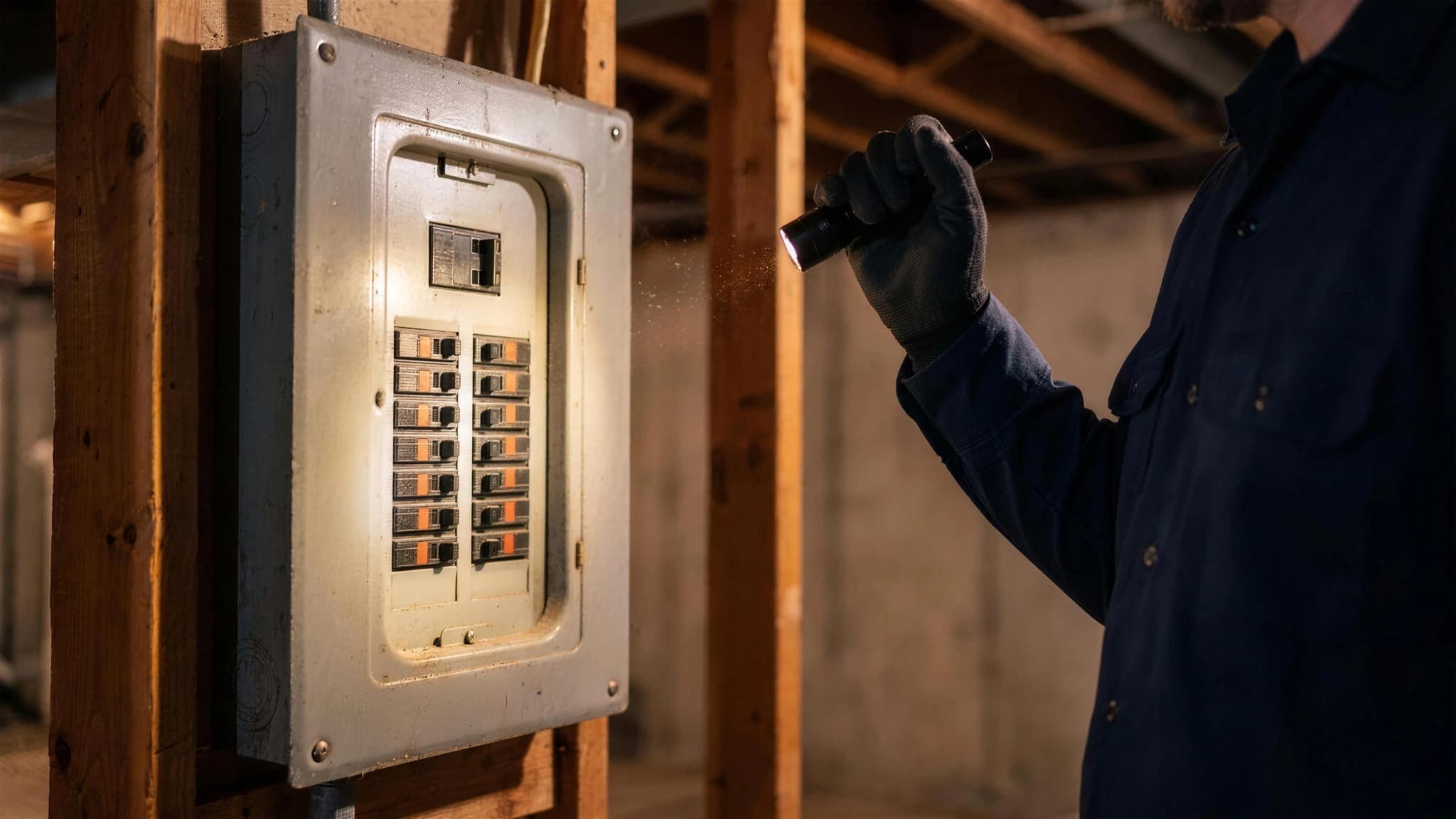
A Federal Pacific panel is a breaker box made by Federal Pacific Electric and sold under the Stab-Lok name, installed in millions of American homes from the 1950s through the 1980s. The problem is simple to state and hard to overstate: independent testing has repeatedly shown that Stab-Lok breakers can fail to trip during an overload or short circuit — the one moment a breaker exists for. A breaker that stays on while a wire overheats inside a wall is how electrical fires start, which is why home inspectors flag these panels, insurers increasingly refuse to cover them, and electricians recommend replacement.
The Seattle area has plenty of housing stock from exactly the FPE era — postwar ramblers in Shoreline and Lynnwood, split-levels in Bellevue and Everett, 1970s builds all over the Eastside. Below is how to tell whether your home has one, what the testing and court record actually say (and what the much-discussed “recall” really was), what happens at inspection and insurance time, and what a replacement involves — the same conversation we have with homeowners on panel upgrade calls every month.
What Is a Federal Pacific (Stab-Lok) Panel?
Federal Pacific Electric was one of the biggest panel makers in the country during the postwar building boom. Its signature product was the Stab-Lok line — named for the way each breaker “stabs” onto the panel's bus bar with a spring clip instead of bolting on. The design was compact and cheap to install, which is exactly why builders loved it and why so many of these panels are still on garage and basement walls today. The company's panel business collapsed in the 1980s after the testing scandal described below, but the panels it shipped never left.
Age alone isn't the accusation — plenty of 1970s equipment still works fine. The accusation is specific to how these breakers behave when they're actually needed.
Why Federal Pacific Panels Are Considered Dangerous
A circuit breaker has one job: when a circuit draws more current than its wiring can safely carry — an overload, a short, a failing appliance — it trips and cuts the power before the wire overheats. Independent testing of Stab-Lok breakers, going back to the 1980s and repeated since, found them failing that test at rates far beyond what UL standards permit, with double-pole breakers performing worst. When a breaker fails to trip, nothing downstream protects you: the wire itself becomes the fuse, and wires make terrible fuses.
Two more design problems compound it. Some Stab-Lok breakers can sit with the handle looking off while the contacts inside remain connected — so a circuit someone believes is dead may still be live, which is a nasty surprise during any repair. And the stab connection itself can loosen over decades of heating and cooling cycles, creating a high-resistance joint on the bus bar that overheats and arcs — the same failure mode that makes a breaker that keeps tripping look tame by comparison, because here nothing trips at all.
The Part That Matters
“It's worked fine for 40 years” is the most common thing we hear about these panels, and it's true right up until it isn't. A breaker does nothing at all on a normal day — its entire value is the abnormal one. A panel whose breakers have a documented history of not tripping hasn't been proven safe by decades of quiet operation; it's been untested by them.
How to Tell If You Have One
| Where to Look | What Gives It Away |
|---|---|
| Panel door & label | “Federal Pacific Electric,” “FPE,” or “Stab-Lok” on the door or inside the cabinet |
| Breaker handles | Distinctive orange or red stripe on the switch tips |
| Home's era | Built or re-paneled between roughly 1950 and 1990 |
| Panel layout | Many are split-bus — several “main” breakers instead of one main disconnect |
| Paperwork | Old inspection reports or listing disclosures noting FPE or Stab-Lok |
Identification is a look-don't-touch job: opening the door and reading labels is safe; pulling the cover off the interior is not, especially on a panel where an “off” breaker isn't guaranteed to be off. If the label is painted over or missing, an electrician can confirm it in minutes.
Think Your Panel Might Be FPE?
Get It Identified Before It Becomes a Closing-Day Problem
Mad Dog Electric confirms what's on your wall, checks the service feeding it, and gives you a fixed replacement price — free site visit, straight answers, no scare tactics.
Was There Ever an Actual Recall?
No — and knowing the real history helps you weigh the risk honestly. The U.S. Consumer Product Safety Commission opened an investigation into FPE breakers in 1980 after the trip-failure reports surfaced. It closed the case in 1983 without ordering a recall — not because the breakers were cleared, but because the commission said it couldn't reach a conclusion with the data and budget it had. That non-ending is why you'll find both “recalled hazard” and “never recalled” claims online, and both are half right.
The court record is less ambiguous. In 2002, a New Jersey state court ruled in a class action that Federal Pacific Electric had violated the state's Consumer Fraud Act by selling Stab-Lok breakers it knew had not passed the UL tests their labels claimed. Testing fraud is why the brand collapsed in the 1980s — and why the panels still on walls today get treated as a known defect rather than a debatable one. Organizations like the Electrical Safety Foundation International put aging electrical systems high on the home fire-risk list for exactly this class of reasons.
Do You Have to Replace It?
Legally, no. Electrical code isn't retroactive, a panel installed legally in 1972 is grandfathered, and no Washington rule orders FPE panels out of service. Practically, the pressure arrives from three directions. Home inspectors flag these panels by name during a sale, and the buyer's first phone call is to an electrician for a replacement quote — often followed by a renegotiation. Insurance carriers increasingly ask about panel brand and either surcharge, require replacement, or decline the policy. And any new permitted work that touches the panel — a remodel, an EV charger, a heat pump, a service upgrade — has to meet current code, which as a rule means the Stab-Lok cabinet goes.
Our honest take: if the house is staying in the family for years, replace it on your own schedule, when you can pick the timing and pair it with other work. Waiting converts the same job into a rush order during escrow. Homes of this era often carry other period wiring quirks too — if yours still has original 1950s-or-earlier circuits, our knob-and-tube wiring guide covers what that means for the same insurance and safety conversation.
What Replacement Involves & What It Costs
Replacing an FPE panel means removing the old cabinet, breakers and all, and installing a modern load center with new breakers — it is not a breaker swap. New Stab-Lok-compatible breakers are still manufactured, but putting new breakers of a problem design onto a worn bus bar solves nothing, and no reputable electrician recommends it. A typical replacement day: power is disconnected at the meter, the old panel comes off the wall, the new panel goes up, every circuit is re-landed on new breakers, grounding and bonding are brought up to current standards, and the inspector signs off before the job is closed out.
In the Seattle area, a like-for-like replacement at the same amperage typically runs $1,800 to $3,200. Most FPE-era homes have 100-amp service, and many owners take the opportunity to move to 200 amps — typically $2,500 to $7,500 depending on whether the meter base, mast, or service conductors need work too. Our panel upgrade cost guide breaks down every driver of that range. Two silver linings come standard with the new panel: current code (Washington is on the 2023 NEC, with the 2026 edition taking effect December 31, 2026) requires a whole-house surge protective device when service equipment is replaced, and circuits get modern AFCI, GFCI, or dual-function breakers where today's rules call for them — protection the Stab-Lok era simply didn't have.
Panel replacement is permitted, inspected work everywhere in Washington — through the Washington L&I electrical permit system in most of the region, or SDCI for homes inside Seattle city limits. That permit record is the document your insurer and your future buyer will both want to see.
When to Call a Licensed Electrician
- Your panel door says Federal Pacific, FPE, or Stab-Lok — or the breakers have the telltale orange-striped handles
- A home inspector or insurance carrier has flagged the panel during a sale, purchase, or policy renewal
- Breakers in the panel feel hot, smell burnt, buzz, or a circuit stays live when its breaker is switched off
- You're planning an EV charger, heat pump, remodel, or any project that adds load to an FPE-era panel
- You simply don't know what brand your panel is — a five-minute look settles it for good
A Federal Pacific panel isn't a reason to panic tonight — it's a reason to plan a replacement rather than inherit someone else's deadline. Mad Dog Electric is a licensed Washington electrical contractor (MADDODE754OB) that identifies, quotes, and replaces FPE and other legacy panels with permitted, inspected work across the greater Seattle area — from a straight swap to a full service upgrade.
FAQ
Frequently Asked
Questions
Got a Stab-Lok on the Wall?
Mad Dog Electric identifies and replaces Federal Pacific panels across Seattle, Bellevue, Everett, and the rest of the greater Seattle area — free site visit, permitted and inspected work, and a fixed price before anything is ordered.