
Electrical Code & Safety
Whole-House Surge Protectors: What They Do& Why Code Now Requires One
One device at the panel that guards every circuit in the house. Here's how a whole-house surge protector works, when Washington code requires one, and what installation actually involves.
A whole-house surge protector is a small device mounted at your electrical panel that catches dangerous voltage spikes before they can travel down your circuits into appliances and electronics — one unit guarding everything in the house at once. Do you need one? If your home gets a new electrical service or a replaced panel in Washington, the answer is written into code: the 2023 National Electrical Code requires surge protection on every dwelling service, and Washington enforces that edition today. For everyone else it's optional — but it's some of the cheapest insurance you can buy for a house that's increasingly full of circuit boards.
Twenty years ago a surge might have cost you a clock radio. Today the furnace, heat pump, range, washer, garage door opener, and even the light switches can carry control electronics, and a single bad spike can damage several of them at once. Below is how surges actually happen, what a panel-mounted protector does about them, where the code requirement kicks in, and what to expect on cost — the same rundown we give homeowners during panel upgrades across the greater Seattle area.
What a Power Surge Actually Is
A surge — the technical term is a transient over-voltage — is a spike that rides in on top of the normal 120 or 240 volts your wiring carries, lasting a fraction of a second but climbing far above what your equipment is built to handle. Lightning is the dramatic cause, but it's not the common one. Most damaging surges come from mundane sources: the utility switching loads on the grid, power being restored after an outage — a regular event in Puget Sound windstorm season — and large motors inside your own home. Every time an air conditioner compressor, well pump, or refrigerator kicks off, it can throw a small spike back into the wiring it shares with everything else.
Those small internal surges rarely destroy anything outright. Instead they erode electronics gradually — stressing power supplies and control boards a little at a time until something fails early for no visible reason. The big external spikes do the headline damage; the little ones shorten the life of everything in between. Surge protection is aimed at both.
How a Whole-House Surge Protector Works
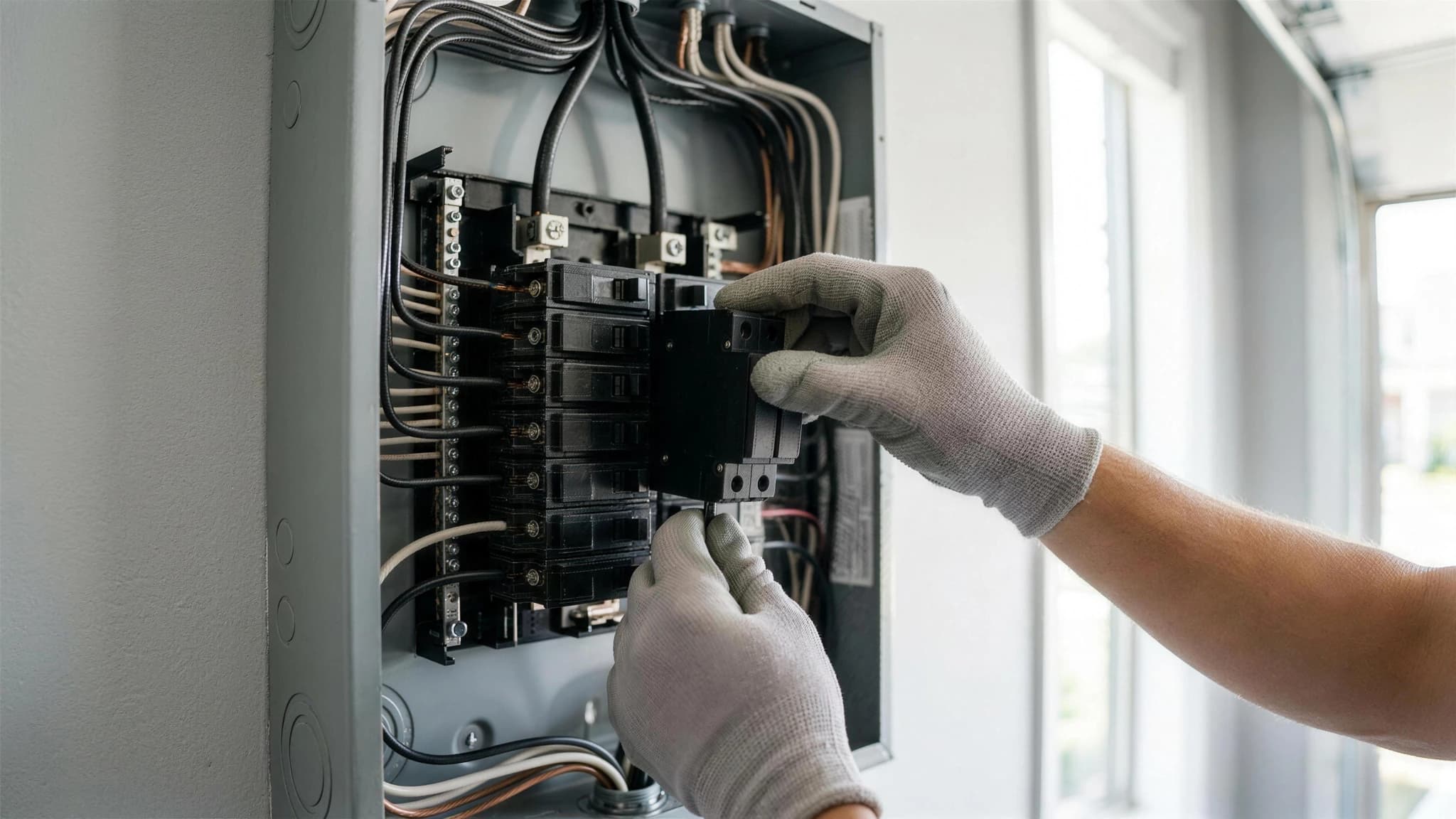
A whole-house surge protective device — SPD in code language — connects at or inside your electrical panel and constantly monitors incoming voltage. Inside are components, most commonly metal-oxide varistors, that stay dormant at normal voltage but become conductive the instant voltage spikes past their threshold. When that happens, the SPD shunts the excess energy to ground in nanoseconds, clamping the spike down before it propagates through the branch circuits to your equipment.
The code recognizes two whole-house types. A Type 1 SPD installs on the line side of your main disconnect — between the utility and your panel — and is built to absorb the largest external events. A Type 2 SPD installs on the load side, inside or beside the panel on a dedicated two-pole breaker, and is by far the more common choice in residential work: simpler to install, less expensive, and fully code-compliant. Type 3 devices are the point-of-use protectors — the surge strips and protected outlets at your TV and computer — which are a supplement, not a substitute.
| What | Whole-House SPD (Type 1/2) | Plug-In Strip (Type 3) |
|---|---|---|
| Where it lives | At the electrical panel | At the outlet, behind one device |
| What it covers | Every circuit in the house | Only what's plugged into it |
| Handles hardwired gear | Yes — HVAC, range, EV charger, well pump | No — plug-in equipment only |
| Surge capacity | Rated in tens of thousands of amps | Far smaller — easily overwhelmed alone |
| Installation | Licensed electrician, permitted work | Plug it in |
Layers, Not Either/Or
A whole-house SPD doesn't make surge strips obsolete, and surge strips can't do the panel unit's job. The panel-mounted device knocks a large spike down to a small one; a quality point-of-use protector at your sensitive electronics cleans up the remainder. Homes with expensive plugged-in gear — home office, media room, gaming rigs — should run both layers.
One Visit, Every Circuit Protected
Add Surge Protection at the Panel
Mad Dog Electric installs code-compliant whole-house surge protection as a stand-alone visit or as part of any panel job — free site visit, a straight recommendation on the right device for your panel, and a fixed price before any work starts.
When Washington Code Requires One
Washington adopts the National Electrical Code statewide through L&I, currently the 2023 edition, with the 2026 NEC scheduled to take effect December 31, 2026. Surge protection entered the code in the 2020 cycle and carries through the 2023 edition as Section 230.67, which requires every dwelling unit service to have a Type 1 or Type 2 surge protective device installed in or adjacent to the service equipment.
The part homeowners miss is that the same section applies whenever service equipment is replaced. In practice, that means three situations trigger the requirement:
- New construction — every new home gets one
- A service upgrade — say, moving from 100 to 200 amps for a heat pump or EV charger
- Replacing an old or failing panel where the service equipment changes — the SPD goes in as part of the job
Code isn't retroactive, so if your panel hasn't been touched since before the requirement existed, you're not obligated to add one. But if a panel upgrade is anywhere in your plans, surge protection will be part of it — and folding it in during panel work is the cheapest it will ever be. Inside Seattle city limits the work is permitted and inspected under the Seattle DCI electrical code, which is based on the same NEC; everywhere else in the state, permits run through L&I.
What to Look For in a Surge Protector
Not every SPD is equal, and the spec sheet actually matters here. The things worth checking:
- UL 1449 listing — the safety standard for surge protective devices; don't install anything without it
- Surge current rating — how many amps the device can divert, rated in kA; bigger numbers mean more headroom and longer life
- Voltage protection rating (VPR) — the let-through voltage after clamping; lower is better for sensitive electronics
- Status indicators — lights that confirm the sacrificial components inside are still alive
- Panel compatibility and space — a Type 2 unit typically needs a two-pole breaker position, which crowded panels don't always have
Installation quality matters as much as the device. An SPD works by getting surge energy to ground fast, so the connecting leads need to be as short and straight as possible, and the house's grounding system has to be sound — a top-shelf device on a poor ground is theater. This is also why some homeowners pair the SPD with a smart electrical panel during an upgrade: one modernization visit, every circuit monitored and protected.
What It Costs in the Seattle Area
A quality residential Type 2 SPD typically runs about $70 to $250 for the device itself, depending on surge rating and brand. Installed by a licensed electrician as a stand-alone visit — device, dedicated breaker, permit, and labor — whole-house surge protection in the Seattle area typically lands in the $300 to $700 range. The main variables are the device chosen, whether your panel has two free breaker spaces, and whether any grounding corrections are needed for the SPD to do its job.
Added during a panel replacement or service upgrade, the incremental cost drops — the panel is already open, the permit is already pulled, and the electrician is already there. Compare either number against a single failed heat pump control board or a fried induction range, and the math tends to settle itself.
What a Surge Protector Won't Do
Worth being clear-eyed about the limits. An SPD does nothing for outages, brownouts, or voltage sags — if your concern is losing power in a windstorm rather than spikes when it comes back, that problem is solved by backup power, and our whole-house generator guide covers that side of the equation. It won't fix pre-existing wiring problems either: if your lights are flickering or breakers are tripping, those are symptoms of something an SPD can't touch. And no residential device is rated to swallow a direct lightning strike — for that, protection means layers, insurance, and luck. For the realistic threat profile of a Puget Sound home — grid switching, restore transients, and internal motor loads — a properly installed SPD is exactly the right tool. The Electrical Safety Foundation treats layered surge protection as a baseline for modern homes, and the code change reflects the same thinking.
When to Call a Licensed Electrician
- You're planning a panel upgrade or service change — the SPD is required and cheapest to add right then
- You've added expensive hardwired equipment — heat pump, EV charger, induction range — with no surge protection behind it
- Electronics in your home keep dying young, especially after outages or storms
- Your existing SPD's status light is dark, or the house took a major surge event and the unit hasn't been checked since
- You're not sure whether your panel has room, a sound ground, or a compatible device available — a quick look answers all three
Whole-house surge protection went from a nice-to-have to a code requirement because the modern home earned it — there's simply too much electronics in the walls now to leave unprotected. Mad Dog Electric is a licensed Washington electrical contractor (MADDODE754OB) that installs UL-listed surge protective devices as stand-alone visits and as part of every panel upgrade across the greater Seattle area.
FAQ
Frequently Asked
Questions
Ready to Protect Every Circuit at Once?
Mad Dog Electric installs whole-house surge protection across Seattle, Bellevue, Everett, and the rest of the greater Seattle area — free site visit, the right UL-listed device for your panel, and a fixed price before anything is ordered.