
Backup Power & Generators
Whole House Generator Cost: 2026 Seattle-Area Guide
Real 2026 price ranges by generator size, what drives the installed total, and when standby power pays off.
The most common question we get about backup power is the bluntest one: how much is a whole house generator? Honest answer — a fully installed standby system in the Seattle area generally runs $8,500 to $24,000, and where you land has less to do with the machine on the pad than with your gas line, your panel, and how far the unit ends up from the meter.
Equipment is what everyone shops online. Installation is what moves the number. Two identical units a mile apart can finish five thousand dollars apart — one has a gas meter fifteen feet away and a modern 200-amp panel, the other needs eighty feet of trenched gas line and a panel upgrade first.
Below: 2026 cost ranges by size, what drives the installed total, how to size without overbuying, and how standby compares to a whole-home battery — the same walkthrough we do on site for whole house generator installation across Snohomish and King County.
What a Whole House Generator Actually Is
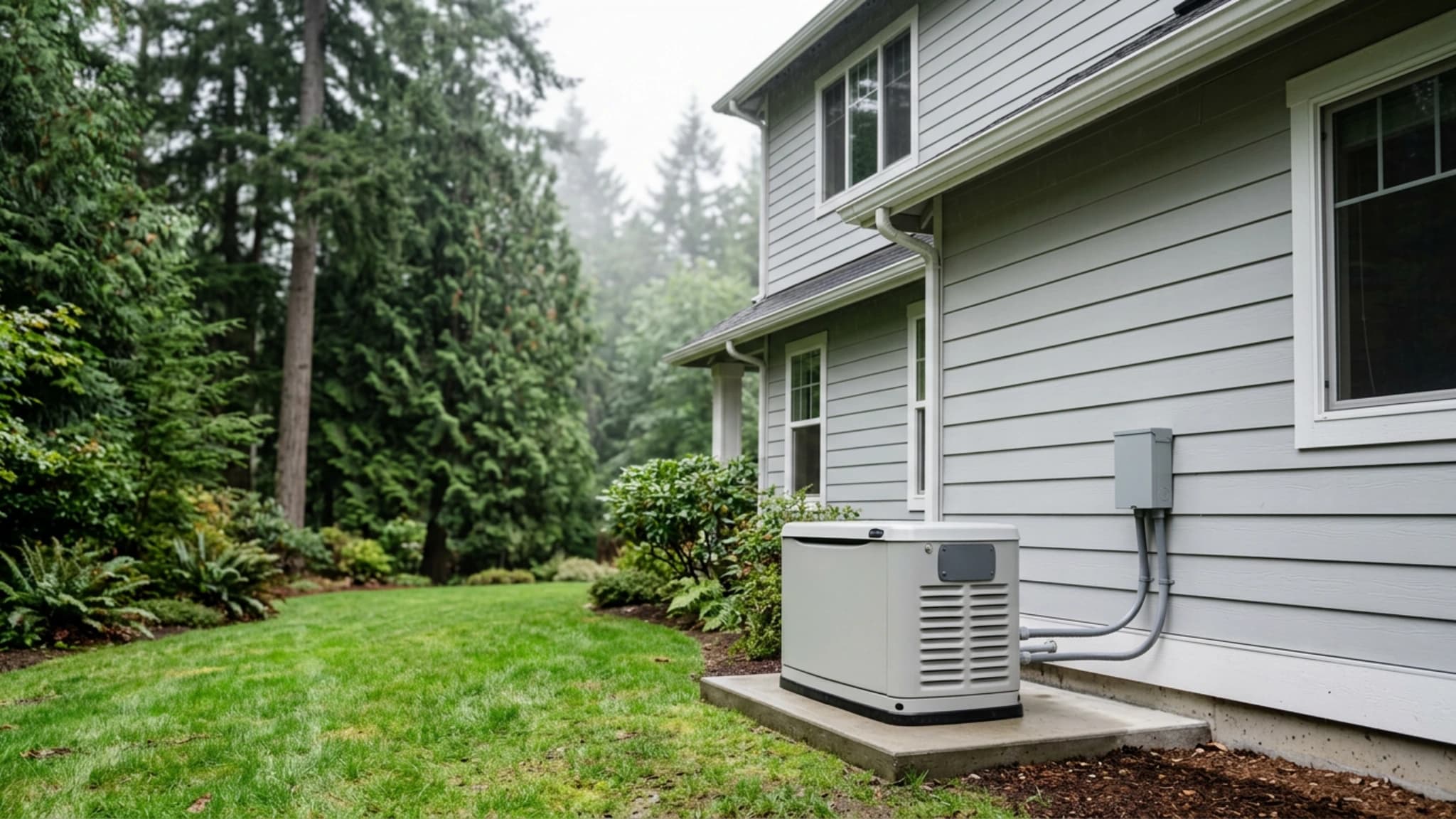
A whole house generator — the trade calls it a standby generator — is a permanently installed engine that sits outside on a pad, roughly the footprint of a central air conditioner. It's hard-wired into your panel through an automatic transfer switch and fed by a fuel line instead of a gas can. When the utility drops, the switch starts the generator and moves the house onto it within seconds; when power returns, it reverses and shuts down. Nobody has to be home.
That's the whole difference from a portable. A portable looks like the obvious answer until you've lived through an outage with one: you go outside in the storm to start it, refuel every eight to twelve hours including at 3 a.m., keep it clear of windows because of carbon monoxide, and it can't start itself while you're asleep. A standby system costs several times more. What you're buying is that it works without you.
Whole House Generator Cost in 2026, by Size
These are the ranges we see on real Seattle-area jobs in 2026 — typical estimates that vary by site, not a price list. Equipment is the generator and transfer switch alone; installed is all-in: unit, switch, pad, gas line, electrical, permits, and startup.
| Size | Equipment Only | Installed Total | Typical Fit |
|---|---|---|---|
| ~10 kW | $3,000 – $4,500 | $8,500 – $12,000 | Small home, essential circuits |
| 14 kW | $4,000 – $5,500 | $10,000 – $14,000 | Small to mid-size home, load managed |
| 18 kW | $5,000 – $7,000 | $12,500 – $17,000 | Most three-bedroom homes |
| 22 kW | $5,500 – $8,000 | $14,000 – $19,000 | Whole house on 200-amp service |
| 26 kW+ | $8,000 – $12,000 | $17,000 – $24,000 | Large home, heat pump plus EV charging |
Equipment is usually only a third to half of the whole house generator cost installed. When you find a 22kW generator online for six thousand dollars, that's the box on a pallet — the standby generator installation cost is everything after it.
Brand moves the number less than people expect. Generac generator installation cost, Kohler, and Briggs & Stratton land in similar territory for a comparable air-cooled unit at the same kW — Generac has the widest parts network, Kohler runs a couple of decibels quieter, and the labor is nearly identical. The step from 22 kW to 26 kW is the steep one, where air-cooled units hand off to liquid-cooled.
What Drives the Cost to Install a Whole House Generator
When two quotes for the same generator come back thousands apart, one of these is the reason:
- The gas line run— the biggest swing factor. Ten feet across a side yard is nothing; eighty feet trenched under a driveway is thousands. The pipe also has to be sized for the generator's BTU draw on top of what's already on the meter
- Transfer switch type— a service-rated whole-panel switch costs more than an essential-circuits switch, but it's what lets the house behave normally
- Panel condition — a full, undersized, or obsolete panel gets handled first. A panel upgrade bundled into a generator job is common, and it's the line item most likely to surprise you
- Pad, placement, and trenching — a composite pad on level ground is quick; poured concrete on a slope is not
- Permits and inspection — an electrical permit plus a separate gas piping permit, both inspected. Modest, but real, and it belongs in the quote
The Only Number That's Actually Yours
Every range on this page is a planning figure built from jobs we've done in this region — useful for budgeting, useless as a promise. The only real number is a site-specific quote from someone who has looked at your panel, walked your gas line, and measured the run to the pad.
Sticker Shock or Fair Price?
Get a Line-by-Line Generator Quote
Mad Dog Electric is a licensed Washington electrical contractor installing standby generators across Snohomish and King County — free site visit, a real load calculation, and a fixed price before anything gets ordered.
Whole House Generator Sizing: How Big Do You Need?
Essential circuitsmeans a smaller unit feeding a sub-panel with a chosen set of loads — furnace or air handler, fridge, well pump, sump pump, internet, a few lights and outlets. It's the cheapest path to not being miserable. The tradeoff is that the range, dryer, and AC are usually off the list.
Whole house with load management means a larger unit and a service-rated switch carrying the entire panel, with modules that temporarily shed the biggest loads — AC compressor, electric range, water heater, EV charger — so two never start at once. That's what lets an 18 or 22 kW unit run a house that on paper could draw far more.
It's why a 22kW generator is the standard pairing with 200-amp service. It doesn't produce 200 amps — a 22 kW unit puts out roughly 90 amps at 240 volts — but with load management it covers how a household actually uses power, which is never everything at once. A smart electrical panel with circuit-level control makes that easier still.
New large loads are what legitimately change the math — a heat pump conversion, a shop, a second EV. If a home EV charger is on the roadmap, say so during the load calculation. And skip the online calculators: most size off square footage, while a real load calculation reads your equipment nameplates and accounts for the startup surge that decides whether a generator can start a well pump at all.
Natural Gas vs Propane in the Puget Sound Region
Most of our installs run on natural gas, and if you already have gas service it's almost always the right call. A natural gas generator for home standby power never needs refueling — the line that feeds your furnace feeds the generator, and it keeps flowing during a windstorm because it's underground.
Propane is the answer where there's no gas main — much of rural Snohomish County, the edges of the Sammamish plateau, and homes at the end of long private roads. It stores indefinitely and burns a little hotter, so most units are rated slightly higher on propane. The tradeoffs are the tank (500 gallons is typical), its setbacks, and refills during a long outage.
In Everett, Lynnwood, Edmonds, and most built-up parts of the county, gas is already at the house and the only questions are pipe size and run length. Farther out, propane is often the only option — and that tank belongs in the budget from the start.
Generator vs Battery Backup
Whole-home batteries have gotten genuinely good, so here's the honest comparison, including the parts that don't favor selling you a generator. Batteries win on silence, zero emissions, no fuel line, no annual service, and instant transfer with no ten-second gap. They pair with solar, so they can recharge themselves. Short, frequent outages? A battery covers them elegantly and you never hear it.
Generators win on duration. A typical home battery holds 10 to 20 kWh. A heat pump, a well pump, and a normal household eat into that quickly, and without solar production — modest at best in a Pacific Northwest December — there's nothing to refill it with. A generator on a gas line runs for days, and it starts heavy motor loads more comfortably than most inverters do.
Cost lands in similar territory for a meaningfully sized battery, so it isn't a budget decision — it's a duration decision. Short outages and solar already on the roof point to a battery. Multi-day windstorm outages, a well pump, electric heat, or medical equipment point to a generator. Some homeowners do both, which is honestly the best of it.
Permits & Inspection in Washington
A standby generator is permitted work on two fronts: an electrical permit and inspection, plus a gas piping permit and inspection normally pulled by the gas fitter. Both pass before the job is finished.
Which office issues the electrical permit depends on your address. Washington L&I handles electrical permitting and inspection across much of the state, but a number of cities here run their own program instead. That changes the paperwork and the fee schedule, not the standard the work is held to. Fees vary by jurisdiction and scope, so we confirm the exact path and cost for your address as part of the quote.
Placement gets inspected too, against your unit's own installation manual rather than one universal number. On common air-cooled units that means roughly 18 inches off the house, 5 feet from any operable door, window, or fresh-air intake, clear space at the ends and overhead, plus room to service it — but the exact figures come off your model's listing. Those clearances are why the obvious spot next to the meter sometimes doesn't work, and why a gas run occasionally ends up longer and pricier than expected. An unpermitted generator is a real problem at resale.
Running & Maintenance Cost
A standby generator isn't quite set-and-forget, but it's close. Budget for three things:
- The weekly self-test — ten minutes or so once a week to prove it works. It barely registers on a gas bill, and you pick the time
- Fuel during an outage — the one that catches people. Expect roughly $20 to $60 per day of continuous running on natural gas, more on propane, varying with load and rates
- Annual service — oil and filter, plugs, air filter, valve check, battery test. A whole house generator maintenance cost of roughly $250 to $500 a year is typical for an air-cooled unit, plus a battery every three to five years
One field note worth more than the rest: the most common reason a standby generator fails to start during the storm it was bought for is a dead battery. Skipping annual service is how a fifteen-thousand-dollar system becomes a lawn ornament.
When a Backup Generator Pays Off in Snohomish & King County
This region has a specific outage profile: fall and winter windstorms, tall second-growth evergreens over the lines, and neighborhoods at the end of long feeders that get restored last. A backup generator cost that looks steep in July looks different on day three of a December outage. Where it clearly pencils out:
- Well water — no power means no water, the fastest way an outage stops being an inconvenience
- Medical equipment — CPAP, oxygen, or anything somebody depends on overnight
- A home office — two days of lost billable work adds up fast
- A sump pump doing real work — one flooded basement costs more than the generator would have
- Electric heat or a heat pump — a well-insulated house still gets cold within a day
- An outage-prone address — foothills, heavy tree cover, or a history of multi-day restorations
If none of that describes you and you lose power for two hours a year, a decent portable and a properly installed manual interlock is a rational answer, and we'll say so rather than sell you a standby unit you don't need. Standby earns its price on the multi-day outage.
Whatever the ranges above say, your number is your house. The gas run, the panel, the placement, and the size set the whole home generator cost on your property, and none of it is knowable from a table. Mad Dog Electric is a licensed Washington electrical contractor handling generator installs — and panel upgrades when a job needs one — across the greater Seattle area, starting with a free site visit.
FAQ
Frequently Asked
Questions
Thinking About a Whole House Generator?
Mad Dog Electric sizes, installs, and permits standby generators across Everett, Lynnwood, Bothell, and the rest of the greater Seattle area — free site visit, real load calc, fixed price before anything is ordered.